


Facilitated PNF Stretching
Approval Codes
NCBTMB #70056734 CE Broker #20-604833
Available Course Formats
Test Information
- Number of Questions: 65
- Passing Score: 70%
- Test Only Option: Available for $129.00
Facilitated PNF Stretching for Massage Therapists
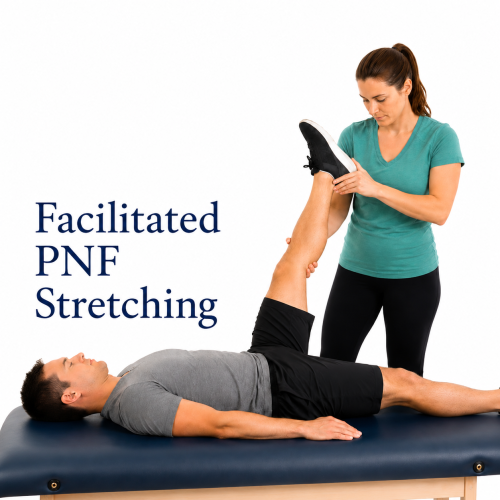
Proprioceptive neuromuscular facilitation (PNF) stretching is one of the most clinically effective methods available for improving flexibility, restoring range of motion, and enhancing neuromuscular coordination. This course is built around Facilitated Stretching, Fourth Edition by Robert E. McAtee and Jeff Charland the most trusted resource for PNF stretching in manual therapy education and gives you the knowledge, visual instruction, and ready-to-use protocols to integrate these techniques confidently into your practice.
With step-by-step guidance, full-color visuals, and access to high-definition video demonstrations of over 90 stretches, you will gain both the conceptual foundation and the hands-on fluency to apply PNF techniques across a wide range of client presentations from competitive athletes to clients managing chronic tightness or age-related mobility limitations.
Continuing Education Details
| CE Hours | 18 Massage Therapy CEUs |
| CE Classification | Kinesthetic (teaches specific techniques for use with clients during massage therapy sessions) |
| Florida Licensees | This course is classified as "General" for CE Broker purposes only 5 of 18 hours apply toward Florida license renewal |
| Approved By | NCBTMB (#280672-00) | Florida (#MCE-326) | New York (#0019) | AMTA | ABMP |
| CE Broker | Auto-reported weekly in applicable states (license number must be on file in your account) |
| Required Textbook | Facilitated Stretching, 4th Edition with Online Video by Robert E. McAtee and Jeff Charland |
| Test | Online exam certificate available immediately upon passing |
| Tuition | $199 + shipping (textbook by mail + online test) or $129 (test only student supplies own textbook) |
Course Overview
PNF stretching works by cycling through three stages: stretching the muscle, performing an isometric contraction against resistance, and then stretching again to achieve a greater range of motion than passive stretching alone can produce. This method is more effective than traditional static stretching for improving flexibility, muscle balance, and neuromuscular control and this course teaches you to apply it systematically and safely across the full range of clinical scenarios you are likely to encounter.
The course covers PNF technique from the ground up, including the neurological basis of facilitated stretching, spiral-diagonal movement patterns, and safety guidelines then moves into detailed instruction on stretches for every major joint and muscle group. Activity-specific routines and self-stretch variations mean you will leave with protocols you can use immediately in your next session.
Learning Objectives
By the end of this course, you will be able to:
- Explain the neurological principles behind PNF stretching, including reflex actions and isometric contractions
- Describe spiral-diagonal movement patterns and apply them in facilitated stretching technique
- Perform PNF stretches for the torso, neck, lower extremity, and upper extremity using correct partner-assisted and self-stretch technique
- Select and apply activity-specific stretching routines for clients with sports performance, general mobility, or chronic tightness goals
- Adapt PNF technique for use in treatment room, mat, chair, and gym settings
- Assess muscle function and range of motion limitations to guide appropriate stretch selection
- Educate clients in self-stretch techniques for use between sessions
Key Topics Covered
Part I: The Foundations of PNF Stretching
- Soft tissue responses to stretching muscle interactions, contraction types, and relevant reflexes
- History and basis of PNF, development of the method and its transition from rehabilitation into manual therapy
- PNF techniques, contract-relax, hold-relax, and spiral-diagonal pattern stretching
- Facilitated stretching guidelines and safety considerations
- Spiral-diagonal patterns, how to teach and apply lower and upper extremity patterns, including strengthening integration
Part II: The Stretches
- Torso and neck: oblique abdominals, lower back, upper trapezius, SCM, scalenes, suboccipitals, levator scapulae
- Lower extremity: hip extensors, flexors, rotators, abductors, adductors; knee extensors; ankle plantar flexors, dorsiflexors, evertors, and invertors; toe flexors and extensors
- Upper extremity: rotator cuff, scapular stabilizers, additional muscles of the arm, elbow, wrist, hand, supinators, and pronators
Activity-Specific Routines
- Everyday Sequence general flexibility and mobility maintenance
- Cycling, golf, ice hockey, running, swimming, throwing and racket sports
- Rusty Hinges designed for clients with limited mobility, chronic stiffness, or age-related range-of-motion challenges
Course Materials
This course is based on Facilitated Stretching, Fourth Edition with Online Video by Robert E. McAtee and Jeff Charland. The textbook features a full-color interior with over 320 photographs and illustrations, graphic overlays highlighting muscles being stretched and isometric effort, and an online video package with high-definition demonstrations of more than 90 stretches and four sample stretching routines.
Please note: Technical support for the online video platform is provided by the book's publisher. The Institute of Somatic Therapy is not able to provide technical support for the publisher's online platform.
Tuition & Enrollment Options
Option 1: Textbook by Mail + Online Test: $199 USD + shipping
Choose this option if you would like the textbook shipped to you. Your copy will ship through an outside bookseller (such as Amazon.com or Barnes & Noble). Please allow approximately five business days for arrival. We will send you shipping information when it becomes available. If your textbook has not arrived as scheduled, please notify us within one business day so we can investigate promptly locating a lost package becomes more difficult with each passing day. Because this is a special order, no refunds are available.
Option 2: Test Only: $129 USD
If you already own the textbook or prefer to purchase your own copy through the publisher (including their online resources) or a bookseller such as Amazon or Barnes & Noble, you may enroll for the online test only. No additional materials will be provided. You will complete the test based on your own study of the textbook to earn your continuing education certificate.
Notice to International Students: Due to the complexity of international shipping, we encourage students outside the USA to explore purchasing the textbook locally and using our test-only enrollment option. If you do place a shipping order and your package is lost in delivery, it will be your responsibility to file a claim with the delivery carrier in your country. By ordering from our website for shipment outside the USA, you are agreeing to these terms.
Who This Course Is For
- Licensed massage therapists who want to expand their clinical toolkit with evidence-based flexibility and range-of-motion techniques
- Therapists working with athletes or physically active clients seeking performance enhancement and injury prevention support
- Practitioners working with general wellness clients including older adults or those with chronic tightness who need accessible, effective mobility work
- Manual therapists and bodyworkers seeking 18 NCBTMB-approved kinesthetic CEUs in a clinically substantive course
- Any massage therapist who wants structured, immediately applicable stretching protocols they can introduce into sessions right away
Course & Certification Details
Test & Certificate: The online exam is completed through your student account at MassageCredits.com. Upon passing, your certificate of completion is available immediately for printing or download as a PDF. To see how our online courses and testing work, we invite you to take our free sample course.
CE Broker Reporting: Institute of Somatic Therapy automatically reports completions to CE Broker in applicable states, provided your license number is on file in your account. Reports are submitted weekly. To verify or add your license number, log in to your account and select "Edit" if your license is not shown. This course is classified as "General" for CE Broker purposes and does not fulfill any required live or hands-on classroom hours.
Florida Licensees: This course counts as "General" hours for CE Broker purposes. Only 5 of the 18 hours apply toward Florida license renewal. For a list of courses that count toward approved distance learning in place of live hours, please see our Florida renewal package page.
Provider Approvals: Institute of Somatic Therapy is an NCBTMB Approved Provider (#280672-00), approved by Florida (#MCE-326) and New York (#0019). Courses are also accepted by AMTA, ABMP, and most individual states. Some states limit the number of online or home-study hours permitted per renewal cycle. Please review our State Guidelines section for requirements specific to your state.
Note: CE regulations change. Your state licensing board holds you responsible for knowing the requirements that apply to your license.
Frequently Asked Questions
What is PNF stretching and how is it different from regular stretching?
PNF (Proprioceptive Neuromuscular Facilitation) stretching involves a three-stage cycle: stretching the muscle, performing an isometric contraction against resistance, and then stretching again to achieve greater range of motion. This method is more effective than traditional static stretching for improving flexibility, muscle balance, and neuromuscular control.
Does the course include techniques that can be used without a partner or outside a treatment room?
Yes. Most techniques include both partner-assisted and self-stretch versions. The course also covers how to apply facilitated stretching in non-clinical environments on a mat, chair, or gym equipment making it well suited for client self-care education and athletic populations outside the treatment room.
Are there pre-designed routines I can use with clients who have specific sports or mobility needs?
Yes. The course includes complete stretching routines tailored for cycling, running, swimming, golf, ice hockey, and throwing and racket sports, as well as a general-use Everyday Sequence and a Rusty Hinges routine designed for older adults or clients with limited mobility. These ready-to-use protocols make implementation straightforward in any practice setting.
Is this course appropriate for massage therapists who do not work with athletes?
Absolutely. While PNF stretching is widely used in sports medicine, this course includes routines and modifications for non-athletes, including clients with limited mobility, chronic tightness, or age-related stiffness. The Rusty Hinges routine and Everyday Sequence are designed specifically for general wellness clients.
Powered by Froala Editor