


Anatomy Fascial Lines
Approval Codes
NCBTMB #70056732 CE Broker #20-1375568
Available Course Formats
Test Information
- Number of Questions: 54
- Passing Score: 70%
- Test Only Option: Available for $109.00
Anatomy of Fascial Lines
A deep-dive into the connective tissue pathways that shape posture, movement, and pain and how to use that knowledge in every session.
NCBTMB Approved CE Broker Approved Self-Paced Online 54-Question Test Printable Certificate
Continuing Education Details
| Category | Massage Therapy Continuing Education |
| Subcategory | Massage Concepts and Techniques |
| Approvals | NCBTMB Approved | CE Broker Approved |
| Assessment | 54-Question Comprehensive Test |
| Format | Fully Online, Self-Paced |
| Certificate | Awarded upon passing printable and saveable as PDF |
| Provider | Institute of Somatic Therapy - MassageCredits.com |
Course Overview
Fascia is one of the most misunderstood and most consequential structures in the human body. Once dismissed as mere packing material, we now understand that the fascial system forms a continuous, three-dimensional web of connective tissue that surrounds every muscle, bone, nerve, and organ.
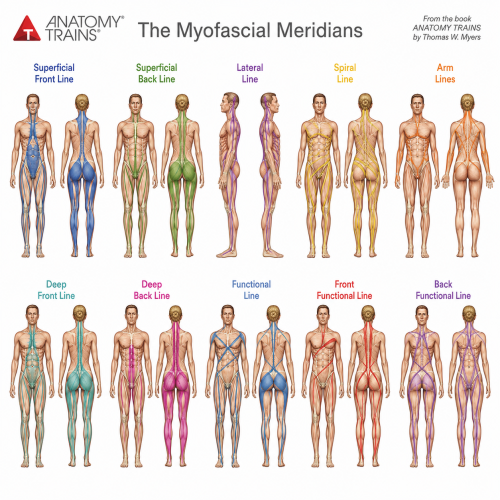
This course takes a deep dive into the anatomy of fascial lines the organized pathways through which tension and movement are transmitted across the body. You will develop a clear, functional understanding of how these lines connect distant regions of the body, and how dysfunction in one area can manifest as symptoms far from the original source. The course is based upon the book-
Anatomy Trains: Myofascial Meridians for Manual Therapists and Movement Professional by Thomas W. Myers
Understanding fascial lines transforms the way you assess and treat your clients. This is anatomy in motion living systems that shape posture, movement, and pain.
Learning Objectives
By the end of this course, you will be able to:
- Define fascia and explain its structural and functional role throughout the body
- Identify and describe the major myofascial meridians, including the Superficial Back Line, Superficial Front Line, Lateral Line, Spiral Line, Arm Lines, and Deep Front Line
- Explain how tension and movement are transmitted along fascial pathways
- Recognize how postural compensation patterns and movement restrictions relate to specific fascial lines
- Apply fascial line anatomy to clinical assessment, connecting symptoms to distant structural imbalances
- Integrate fascial line concepts into treatment planning to improve client outcomes
- Distinguish between superficial and deep fascial layers and understand how each contributes to overall function
Key Topics & Techniques Covered
This course covers the full landscape of fascial anatomy through the following core areas:
- Biology and histology of connective tissue: understanding fascia at a cellular and structural level
- Principles of tensegrity and biotensegrity: how the body maintains structural integrity through continuous tension
- The Superficial Back Line: from the plantar fascia to the scalp, and its role in extension and upright posture
- The Superficial Front Line: from the dorsum of the foot to the skull, and its function in flexion and protection
- The Lateral Line: balancing medial and lateral forces from the fibular head to the skull
- The Spiral Line: wrapping the body in a double helix pattern, supporting rotational movement and postural balance
- The Arm Lines: superficial and deep, front and back, exploring how upper extremity movement connects to the trunk and neck
- The Deep Front Line: the body's deepest core pathway, from the inner arch of the foot through the pelvis, spine, and into the skull
- Fascial dysfunction: how restrictions form, how compensation patterns develop, and how they create referred pain
- Clinical application: reading posture through a fascial lens and selecting appropriate treatment strategies
Who This Course Is For
This course is designed for licensed massage therapists and bodywork practitioners who want to move beyond isolated muscle work and into a whole-body, systems-based approach. It is especially valuable for:
- Therapists working with clients experiencing chronic pain, postural imbalances, or recurring tension patterns
- Practitioners interested in structural bodywork, myofascial release, or Rolfing-informed techniques
- Sports massage therapists seeking to understand movement compensation and injury predisposition
- Clinicians collaborating with physical therapists, chiropractors, or integrative medicine providers
- Any practitioner ready to address the structural roots of client complaints, not just symptoms
- Therapists looking to expand their scope of knowledge and differentiate their practice
No prior background in structural integration is required. A working knowledge of foundational musculoskeletal anatomy is helpful.
Benefits of Taking This Course
Completing this course gives you more than new anatomical knowledge, it changes the way you see the body and the way you work with it.
- Whole-Body Perspective
Identify the structural root of your clients’ patterns, not just where they hurt. - Stronger Clinical Reasoning
Understand how fascial continuity connects distant symptoms to their structural source. - Better Client Outcomes
Apply targeted, line-informed treatment strategies rather than working only locally. - Advanced Credentialing
Earn nationally approved CEU hours while deepening expertise in a rapidly evolving area of bodywork. - Differentiate Your Practice
Stand out as a practitioner with a systems-based, structurally informed approach to massage therapy. - Flexible, Self-Paced Learning
Study on your schedule and access your materials anytime through your student account.
Continuing Education & Certification Details
This course is approved by the National Certification Board for Therapeutic Massage and Bodywork (NCBTMB) and reported through CE Broker, making it valid for license renewal in all applicable states and Canadian provinces where these approvals are recognized.
Upon passing the 54-question comprehensive test with a qualifying score, you will receive a certificate of completion that can be printed directly from your student dashboard or saved as a PDF for your records. Your continuing education hours are automatically reported to CE Broker where applicable.
This course is offered through the Institute of Somatic Therapy at MassageCredits.com. All courses are fully online and self-paced, you may access your materials, resume your progress, and retrieve your certificate at any time through your student account.
Institute of Somatic Therapy
NCBTMB Approved Provider | CE Broker Approved | Available in All 50 States & Canada